
Insta Loan
A home loan can help you buy, build or improve a home without paying the full cost upfront. Through SwipeLoan, you can compare home loan options from ₹5 lakh to ₹2 crore across its network of 100+ RBI-registered lending partners, subject to each lender’s eligibility and property requirements. You can review loan amount, tenure, EMI and other available terms before deciding which lender to approach. Checking your options is free, and SwipeLoan is a marketplace, not a lender.
Compare 100+ lending partners
Explore home loan options from banks and housing finance companies through one platform.
Free eligibility check
Check your possible options before making a formal lender application.
Compare the total cost
Look beyond the headline rate and review EMI, tenure, fees and other applicable charges.
RBI-registered lending partners
Loan offers come from regulated lending partners, subject to their own eligibility rules.
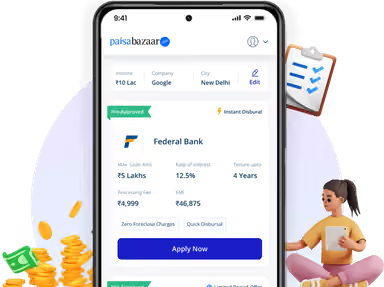

Instant Loan
By submitting this form, you have read and agree to the Credit Report Terms of Use, Terms of Use & Privacy Policy
How a Home Loan Works
A home loan is a secured loan used to purchase, construct, renovate or otherwise finance eligible residential property. The property acts as security for the lender, which is one reason home loans can support larger amounts and longer repayment periods than most unsecured loans.
The process usually looks like this:
Check your affordability and eligibility. Lenders may review your income, age, employment, existing EMIs, credit history and other financial details.
Choose the property and share its details. The lender may review title documents, approvals, valuation and the property’s legal and technical status.
Receive a sanction decision. The lender decides the eligible loan amount, interest rate, tenure and other terms.
Arrange your down payment and purchase costs. The loan may not cover the full property value, and stamp duty and registration are generally separate costs.
Complete legal and technical checks. The lender completes the required documentation and property verification.
Loan disbursal. For a ready property, disbursal may happen according to the purchase agreement. For construction, it can be released in stages based on progress.
Repay through EMIs. Each EMI includes principal and interest according to the loan schedule.
Close the loan and collect documents. Once the outstanding amount is fully repaid, follow the lender’s process for closure, release of security and return of original property documents.
A strong repayment history can also contribute positively to your credit profile, provided repayments are made on time.
How Much of the Property Value Can You Borrow? (LTV)
You usually cannot finance the entire purchase price through a home loan. The loan-to-value (LTV) ratio determines how much of the property’s accepted value a lender may finance.
| Loan amount | Maximum LTV | Illustrative minimum contribution |
|---|---|---|
| Up to ₹30 lakh | 90% | 10% |
| Above ₹30 lakh to ₹75 lakh | 80% | 20% |
| Above ₹75 lakh | 75% | 25% |
Example: what LTV means in practice
For a property valued at ₹60 lakh, the amount you need to contribute depends on the LTV available to you:
| Illustrative LTV | Maximum loan | Your contribution toward property value |
|---|---|---|
| 90% | ₹54 lakh | ₹6 lakh |
| 80% | ₹48 lakh | ₹12 lakh |
| 75% | ₹45 lakh | ₹15 lakh |
Remember that LTV is a ceiling, not an automatic entitlement. A lender can approve a lower amount based on your profile, the property valuation or its own credit policy.
Also keep aside money for stamp duty, registration, legal charges and other purchase-related costs. These can sit outside the home-loan amount.
A second important point: lenders generally base financing on the property value accepted by the lender, not simply on the price you agreed with the seller. A lower valuation can therefore increase the amount you need to fund yourself.
Home Loan Eligibility Criteria
Home loan eligibility varies by lender. SwipeLoan helps you explore options, but the final eligibility decision belongs to the lending partner.
Documents Required
The documents required for an instant loan application depend on the lender and the amount you request. Digital lending can reduce paperwork, but it does not always mean “no documents.”
| Factor | What lenders may assess |
|---|---|
| Age | Minimum age at application and maximum age at loan maturity `[VERIFY lender bands]` |
| Income | Monthly/annual income and repayment capacity `[VERIFY lender-specific floors]` |
| Credit profile | Credit history, score and repayment behaviour |
| Employment | Salaried, self-employed or professional status |
| Employment/business stability | Job continuity or business track record |
| Existing EMIs | Current obligations and resulting FOIR/DTI `[VERIFY threshold by lender]` |
| Property | Title, approvals, valuation, age and legal/technical status |
| Residency/status | Rules for resident applicants and separate policies for NRIs/other eligible categories |
Meeting general criteria does not guarantee approval. Each lending partner evaluates the application independently.
How much home loan can I get on my salary?
There is no single salary-to-loan formula that applies to everyone. Lenders generally look at your income together with existing EMIs and the EMI they believe you can comfortably take on.
For example, suppose your monthly take-home income is ₹80,000 and you already pay ₹10,000 in EMIs. If a lender allows total fixed obligations up to a certain share of income, only the remaining capacity can be considered for your proposed home-loan EMI.
Your age, interest rate, repayment tenure and the property’s value also matter. A co-applicant with eligible income may increase household repayment capacity, but both borrowers remain responsible for the loan according to the agreement.
Types of Home Loans
| Type | Common purpose |
|---|---|
| Home purchase loan | Buying a ready-to-move, resale or under-construction home |
| Home construction loan | Building a house on land you already own |
| Plot / land loan | Buying an eligible residential plot, subject to the lender's terms |
| Home renovation loan | Repairs, upgrades, interiors and eligible renovation work |
| Home extension loan | Adding rooms, another floor or additional space |
| Home loan overdraft / flexi facility | A linked facility that may help borrowers reduce interest on surplus balances, subject to lender terms |
| Home loan balance transfer | Moving an existing housing loan to another lender for potentially better terms |
| Home loan top-up | Additional borrowing against an existing eligible home loan |
Not every lender offers every product. Compare the purpose, eligibility, pricing and repayment structure rather than choosing by product name alone.
Home Loan EMI Calculator
(Interactive calculator widget sits here — inputs: loan amount, interest rate, tenure. Outputs: EMI, total interest, total repayment and, where supported, amortisation details.)
Home loan EMI is generally calculated on the reducing-balance method:
EMI = [P × R × (1 + R)^N] ÷ [(1 + R)^N − 1]
Where:
P = principal loan amount
R = monthly interest rate (annual rate ÷ 12 ÷ 100)
N = total number of monthly instalments
Personal Loan EMI Calculator
Calculate your monthly loan payment
Your Monthly EMI Payment
₹16,134
Table of Contents
ToggleWorked example — ₹50 lakh at 8.5% for 20 years
Illustratively:
Loan amount: ₹50,00,000
Rate: 8.5% p.a.
Tenure: 20 years
Estimated EMI: about ₹43,391
Estimated total repayment: about ₹1.04 crore
Estimated total interest: about ₹54.1 lakh
This is an example calculation, not a SwipeLoan offer. Your actual rate and repayment terms are determined by the lending partner.
Home Loan EMI Reference Table at 8.5% p.a.
| Loan Amount | 10 years | 15 years | 20 years | 25 years | 30 years |
|---|---|---|---|---|---|
| ₹20 lakh | ₹24,797 | ₹19,695 | ₹17,356 | ₹16,105 | ₹15,378 |
| ₹30 lakh | ₹37,196 | ₹29,542 | ₹26,035 | ₹24,157 | ₹23,067 |
| ₹50 lakh | ₹61,993 | ₹49,237 | ₹43,391 | ₹40,261 | ₹38,446 |
| ₹75 lakh | ₹92,989 | ₹73,855 | ₹65,087 | ₹60,392 | ₹57,669 |
| ₹1 crore | ₹1,23,986 | ₹98,474 | ₹86,782 | ₹80,523 | ₹76,891 |
| ₹2 crore | ₹2,47,971 | ₹1,96,948 | ₹1,73,565 | ₹1,61,045 | ₹1,53,783 |
Illustrative calculations at 8.5% p.a. Actual EMI depends on the rate, tenure and lender terms.
Why tenure matters
A longer tenure can make the monthly EMI easier to manage, but you may pay considerably more interest over the life of the loan.
For example, the same ₹50 lakh loan at an illustrative 8.5% p.a. costs more overall when stretched from 20 years to 30 years, even though the monthly EMI is lower.
The right tenure is not simply the one with the lowest EMI. It is the one that gives your household enough monthly breathing room without creating unnecessary long-term interest cost.
Home Loan Interest Rate — What Determines Your Rate?
SwipeLoan does not set the interest rate. The lending partner decides the rate and other commercial terms based on its own policies and your profile.
A lender may consider:
Credit score and repayment history
Income and employment profile
Existing EMIs and obligations
Loan amount and LTV
Property type and location
Loan tenure
Fixed or floating-rate structure
Relationship with the lender, where relevant
Home loan fixed vs floating interest rate
A fixed-rate loan can make budgeting more predictable, while a floating-rate loan may move with the lender’s benchmark or other applicable reference rate. The exact structure depends on the lender and product.
Before accepting any home loan, compare the annualised cost, EMI, applicable fees, repayment schedule and prepayment conditions rather than choosing on the headline rate alone.
Home Loan Fees and Charges
Interest is only one part of the cost of a home loan. Depending on the lender and transaction, you may also encounter several other charges.
| Charge | What it covers |
|---|---|
| Processing fee | Cost charged for processing the loan application `[NEEDS DATA]` |
| Legal and technical / valuation charges | Property title review and valuation `[NEEDS DATA]` |
| Prepayment / foreclosure charges | May apply depending on the loan structure and applicable RBI rules; check the KFS and agreement |
| Penal charges | Charges for overdue payments, subject to lender and regulatory rules `[NEEDS DATA]` |
| EMI bounce charges | Charges associated with a failed repayment instruction `[NEEDS DATA]` |
| Conversion / switch fee | May apply when changing the interest-rate structure or other loan terms `[NEEDS DATA]` |
| Mortgage / documentation charges | May include state-specific stamp duty and other documentation costs |
| CERSAI-related charges | Statutory registration/security-interest related charges, where applicable |
| Insurance | Property or loan-protection products may be offered; check whether cover is optional and how the premium is charged |
| GST | Applicable to eligible fees/charges as per prevailing tax rules; not generally charged on the loan interest itself |
Always review the Key Fact Statement (KFS) and loan agreement before accepting a home loan.
Watch the total cost, not just the rate
A slightly lower interest rate may not always be the cheapest option if the lender charges higher processing, legal, insurance or switching costs. Compare the complete borrowing cost over the period you expect to keep the loan.
Never pay anyone for guaranteed home-loan approval. SwipeLoan will not ask you to transfer money to an individual’s account or share your OTP, CVV or card PIN.
Home Loan Tax Benefits
Home-loan tax benefits depend on the applicable tax rules, the purpose and occupancy of the property, and the tax regime you choose.
| Section | Broad area | Maximum / treatment |
|---|---|---|
| Section 24(b) | Interest on qualifying housing loans | ₹2 lakh in certain self-occupied cases, subject to conditions `[VERIFY current rules]` |
| Section 80C | Principal repayment and certain eligible purchase costs | Up to ₹1.5 lakh within the overall Section 80C limit `[VERIFY current rules]` |
| Section 80EE / 80EEA | Additional interest deductions for eligible historical windows | [VERIFY current availability and conditions] |
Tax treatment can differ between self-occupied, let-out and other property situations and between tax regimes. Do not assume that every home-loan borrower receives the same deduction.
Important: tax rules can change. Verify the applicable provisions at the Income Tax Department’s official source or with a qualified tax adviser before using tax benefits in your financial decision.
Government Schemes for Home Loans
Government housing programmes change over time, so outdated subsidy information should not be reused without checking the official portal.
PMAY-U 2.0 — current urban housing mission
Pradhan Mantri Awas Yojana (Urban) 2.0 is the current central urban housing mission. Its four broad verticals are:
| Vertical | Broad purpose |
|---|---|
| BLC — Beneficiary-Led Construction | Support for eligible families constructing homes on their own land |
| AHP — Affordable Housing in Partnership | Affordable housing delivered through partnerships |
| ARH — Affordable Rental Housing | Rental housing for eligible urban households such as migrants and workers |
| ISS — Interest Subsidy Scheme | Interest-subsidy support for eligible beneficiaries, subject to scheme rules |
Applications and eligibility should be checked through the official PMAY systems.
Documents Required for a Home Loan
A home-loan application generally involves two categories of documentation: the borrower and the property.
Applicant documents
| Requirement | Salaried | Self-employed |
|---|---|---|
| Identity proof | PAN, Aadhaar and/or other accepted ID | Same |
| Address proof | Accepted address document | Same |
| Income proof | Salary slips, Form 16, ITRs `[VERIFY period]` | ITRs, income computation, financial statements `[VERIFY period]` |
| Bank statements | Salary account `[VERIFY period]` | Business/personal accounts `[VERIFY period]` |
| Employment/business proof | Employment or appointment information | Registration, GST/Udyam/professional proof where applicable |
| Existing loan details | Statements for running loans | Same |
| Photographs | As required by lender | As required by lender |
Property documents
| Document | Why it may be required |
|---|---|
| Sale deed / agreement to sell | Establishes the proposed transaction and ownership details |
| Title-chain documents | Helps establish ownership history |
| Approved building plan | Confirms that construction is authorised |
| Local authority approvals | Supports legal/technical verification |
| Completion / occupancy certificate | Often required for completed property, where applicable |
| Society / builder NOC | May be required depending on the property and lender |
| Property-tax receipts | Evidence of property-tax compliance where applicable |
| Encumbrance certificate | Helps identify existing charges on the property |
Start reviewing the property’s paperwork early. A borrower can have strong home-loan eligibility and still face delays or rejection if the property documents do not meet the lender’s requirements.
Home Loan Balance Transfer
A home-loan balance transfer lets you move an existing housing loan to another lender, usually to seek more suitable pricing or terms.
A balance transfer may be worth exploring when:
Your current rate is materially higher than available alternatives.
Your credit profile has improved since the original loan.
You want a different tenure or repayment structure.
You are considering an eligible top-up along with the transfer.
Before switching, compare the interest savings against processing fees, legal/valuation costs, stamp duty and any applicable foreclosure or transfer charges.
The potential savings are usually greater earlier in the loan, when a larger portion of future EMIs is still interest. Later in the tenure, the remaining interest savings may be too small to justify the transfer costs.
You can also ask your existing lender whether a rate-conversion option is available before moving the loan.
Why Home Loan Applications Get Rejected
A home-loan rejection can happen because of the borrower, the property or both.
Reasons related to the borrower
Credit history or score that does not meet the lender’s policy
Insufficient repayment capacity
High existing EMIs
Unstable employment or business income
Age or tenure mismatch
Too many recent formal credit applications
Incomplete or inconsistent documentation
Reasons related to the property
Unclear title
Missing approvals
Building-plan or construction issues
Valuation lower than the agreed purchase price
Property age or condition outside lender policy
Project/builder not accepted by the lender
Existing encumbrance or legal dispute
This is an important distinction. A borrower may be financially eligible while the property is not acceptable to a particular lender. Comparing options and checking property requirements early can help reduce avoidable applications.
Dos and Don’ts for Home Loan Approval
| Do | Don't |
|---|---|
| Check your credit report before applying | Submit multiple formal applications without comparing first |
| Compare home loan offers on overall cost | Choose a lender only because of its advertised rate |
| Verify property documents early | Assume every property is acceptable to every lender |
| Keep a realistic down-payment reserve | Use your entire emergency fund for the down payment |
| Consider a suitable co-applicant where appropriate | Forget that co-borrowers share repayment responsibility |
| Budget for stamp duty, registration and other costs | Assume the sanctioned loan covers every purchase expense |
| Choose a tenure your household can safely service | Select the longest tenure simply to reduce the EMI |
| Read the KFS and loan agreement | Rely only on verbal promises or sales explanations |